






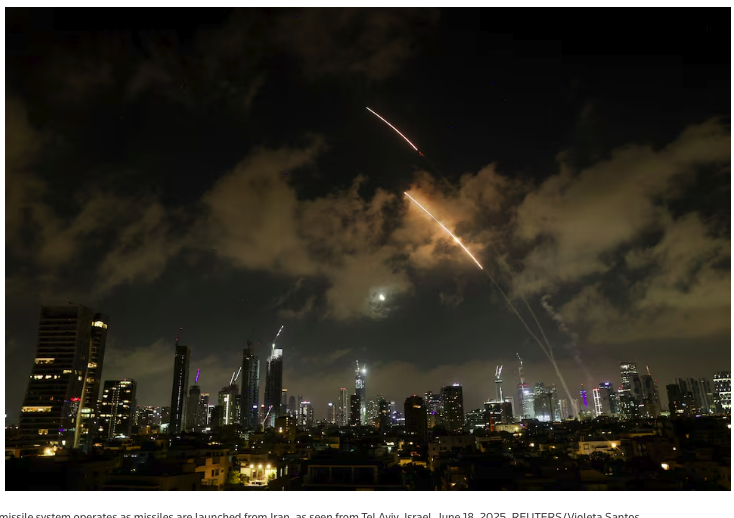
On June 18, 2025, Hostilities between Israel and Iran continued into a sixth consecutive day on Wednesday, as both countries launched new missile strikes. The ongoing exchange has heightened regional tensions and drawn international attention, including from the United States.
According to Israeli military sources, two barrages of missiles were launched from Iran toward Israeli territory in the early hours of Wednesday. Explosions were reportedly heard over Tel Aviv. Meanwhile, Israeli authorities issued evacuation notices to residents in the Tehran area in advance of planned airstrikes on military targets. Iranian media confirmed explosions in both Tehran and Karaj, a city west of the capital.
U.S. President Donald Trump, who has made several public statements about the conflict, called for Iran’s “unconditional surrender” via social media on Tuesday. In his posts, he also suggested that the U.S. has detailed intelligence on Iranian leadership locations, but stated there were no current plans for direct action. A White House official confirmed that Trump spoke by phone with Israeli Prime Minister Benjamin Netanyahu on the same day.
While the president’s remarks have varied in tone, ranging from military threats to indirect diplomatic overtures, no official statement has been made indicating a shift in U.S. military involvement beyond current defensive operations. At the ongoing Group of Seven (G7) summit in Canada, British Prime Minister Keir Starmer stated that there was no clear indication the United States was preparing for direct entry into the conflict.
The White House also confirmed that President Trump met with the National Security Council for 90 minutes on Tuesday to review the situation. Details of the meeting have not been publicly disclosed.
In terms of U.S. military readiness, three officials reported that additional fighter aircraft are being deployed to the Middle East, and the deployment of certain existing aircraft is being extended. Thus far, the U.S. has focused on defensive measures, including intercepting missiles targeting Israel.
Inside Iran, reports indicate that some of Supreme Leader Ayatollah Ali Khamenei’s key military and security advisors have been killed in Israeli strikes. Sources familiar with the situation suggest this may affect strategic decision-making within Iran’s leadership. In response, Iran’s cybersecurity command has reportedly restricted the use of mobile phones and communication devices among government officials, according to Iranian news agency Fars.
Iranian media also reported that Israel has launched cyber operations targeting the country’s digital infrastructure.
The current escalation follows the October 7, 2023, Hamas-led attack on Israel, which triggered the ongoing conflict in Gaza. Since then, Iran’s regional influence—through affiliated groups such as Hamas, Hezbollah, the Houthis, and various Iraqi militias—has faced growing pressure from Israeli military action. In a related development, Syria’s President Bashar al-Assad, a close Iranian ally, has reportedly been removed from office.
The situation remains volatile, with continued risks of wider regional involvement and international diplomatic consequences.